
Parents ask this about their children. Adults ask it about themselves, usually with an unspoken worry attached: am I too old for this?
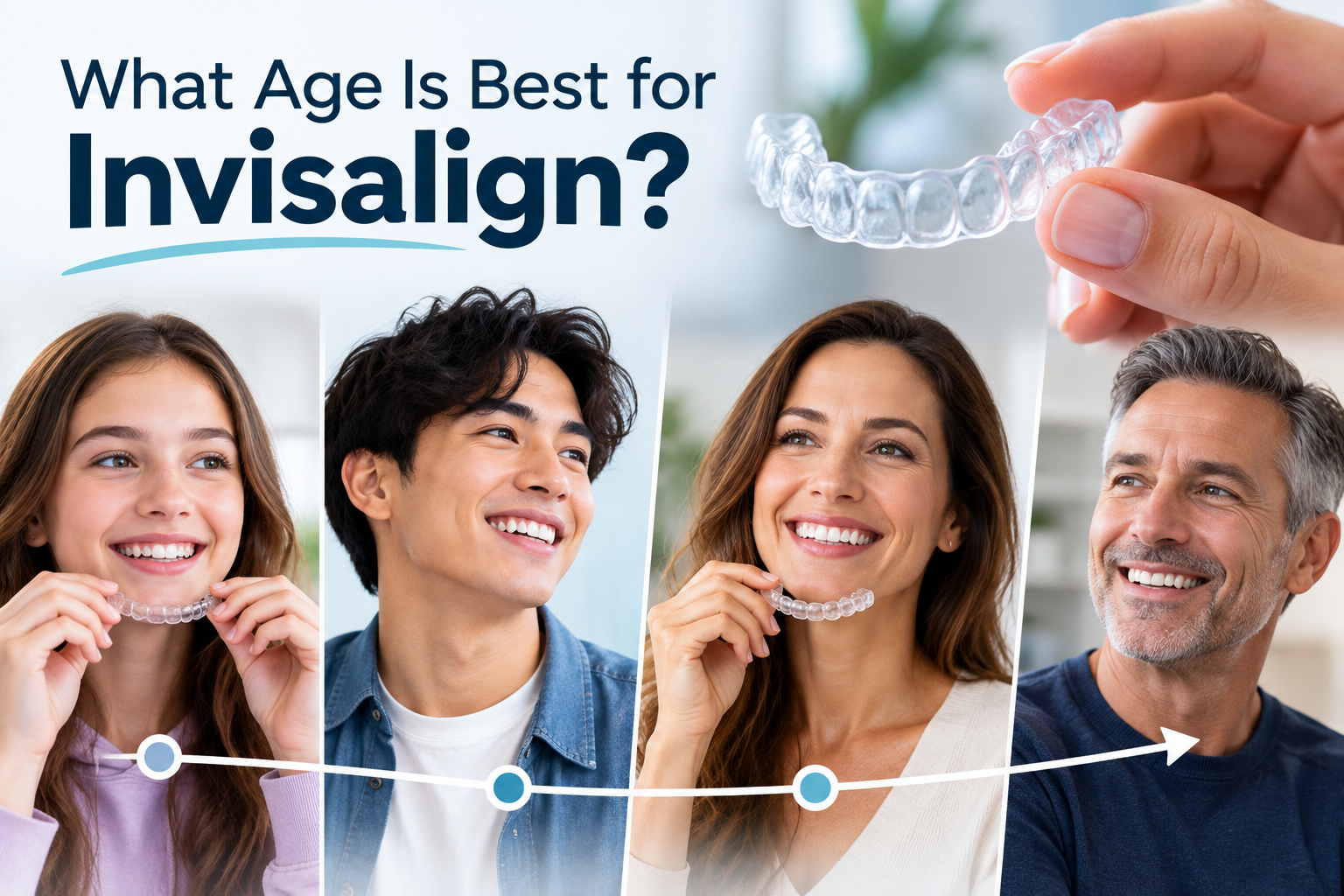
The honest answer is that age is one of the weaker predictors of whether clear aligner treatment will work well. What matters far more is where your teeth and jaw are in their development, what kind of movement your case needs, and whether you will actually wear the aligners.
Here is how each stage really works, so you can walk into a consultation knowing what to ask.
Children: the evaluation matters more than the treatment
The American Association of Orthodontists recommends that children have a first orthodontic evaluation no later than age 7. That recommendation is about looking, not about starting treatment. Most seven-year-olds need nothing at all.
At that age a dentist or orthodontist can see the adult molars and incisors coming in and spot problems that are easier to guide than to correct later, such as a crossbite, a strong crowding pattern, or a jaw growth discrepancy.
Clear aligner systems designed for growing children do exist, and they can accommodate teeth that are still erupting. When early treatment is recommended, it is usually limited and purposeful, aimed at creating room or correcting a bite relationship while growth is still on your side. A second phase often follows in the teenage years.
If a practice recommends a full course of aligner treatment for a young child who still has a mix of baby and adult teeth, ask what specific problem it solves now that could not be solved later. You should get a clear, specific answer.
Teenagers: the strongest window, with one condition
Adolescence is often the most efficient time to straighten teeth. The adult teeth are in or nearly in, the jaw is still growing, and bone responds readily to gentle pressure.
Aligners made for teenagers usually include practical adjustments: wear indicators that fade as the aligner is used, and space built in for teeth that have not fully erupted yet.
The condition is compliance. Aligners are removable, and treatment plans generally assume 20 to 22 hours of wear a day. A teenager who takes them out through lunch, practice, and the whole evening will fall behind the plan, and the aligners will stop tracking to the teeth.
This is a genuine conversation to have before you commit, not a reason to rule aligners out. Plenty of teenagers do very well with them, especially the ones who chose them.
Adults: the group most often talked out of it by a stranger on the internet
Adults make up a large share of clear aligner patients, and the biology is on your side more than you might expect. Teeth move through bone throughout life. That is the entire reason retainers exist.
Adult treatment does come with real differences:
- No growth to work with. A jaw size or position problem in an adult cannot be guided by growth. Correcting it may call for other tools, and in some cases surgical input. Aligners can still handle the tooth alignment part of that picture.
- Gum health comes first. Moving teeth through bone that is inflamed or already reduced by periodontal disease can accelerate the damage. Active gum disease should be treated and stabilized before orthodontic movement begins. This protects both the result and the teeth holding it.
- Existing dental work changes the plan. Crowns, bridges, implants, and veneers behave differently under aligner movement. An implant does not move at all, so it becomes a fixed point the plan has to design around.
- Movement can run slower. Denser adult bone and a long history of settled positions can lengthen treatment somewhat compared with a teenager.
None of these rule out treatment. They shape it, and they are the reason an adult case deserves a thorough exam rather than a quick look.
Patients in their sixties and beyond
There is no upper age limit. What decides candidacy at 65 is what decides it at 35: the health of your gums and the bone supporting your teeth, the condition of your existing dental work, and the movement your case requires.
Older adults often come in with a specific, contained goal. Crowding that reappeared decades after braces. A tooth that drifted after a loss. Alignment needed before a crown or an implant can be placed properly. These are frequently very manageable cases.
What actually decides your candidacy
Whatever your age, the evaluation looks at the same short list:
- Whether your bite problem is a tooth position issue or a jaw relationship issue
- How much movement, and what kind, your teeth need
- The health of your gums and supporting bone
- Existing dental work and how it interacts with the plan
- Your ability and willingness to wear the aligners as prescribed
Some cases are better served by fixed braces, and an honest practice will tell you that.
Straightening in Beverly Hills, planned before it starts
At Dental Group of Beverly Hills, an Invisalign consultation begins with a digital scan using our iTero 3D scanner. No impression putty, and you see a preview of the proposed result before treatment begins.
Dr. Tariq Jabaiti earned his DDS at the world-renowned Herman Ostrow School of Dentistry at USC, where he serves as a Faculty Professor. Dr. Nuriel Lavi brings a long-standing reputation for precision and a warm, attentive manner. We examine gum health, existing restorations, and how your teeth actually come together before we quote anything.
If your case would be better served by a different approach, or by an orthodontic specialist, we will say so. Patients tell us regularly that this is why they stayed. Our $49 per month membership plan also includes 20 percent off all services, Invisalign included, for patients without dental insurance.
Find out where you stand
The only way to know whether you are a candidate is an exam. It is a short appointment, and it ends with real information instead of a guess.
Book your smile consultation today. Call (310) 271-3003 or book online, and see your options in 3D before anything begins.
Dental Group of Beverly Hills, 8641 Wilshire Blvd, Suite 125, Beverly Hills, CA 90211.
Frequently Asked Questions
What is the youngest age for Invisalign?
Clear aligner systems exist for children who still have a mix of baby and adult teeth, generally from around age 6 or 7 onward, and they are used for specific early problems rather than routine straightening. The American Association of Orthodontists recommends a first orthodontic evaluation no later than age 7, which is an assessment rather than a commitment to treatment. Whether a young child should start depends on the specific bite issue found.
Am I too old for Invisalign?
There is no upper age limit for orthodontic treatment. Teeth move through bone throughout life, which is why retainers are needed after treatment at any age. Candidacy in older adults depends on gum and bone health, existing dental work, and the type of movement required rather than on the number of years.
Is Invisalign better for teenagers or adults?
Adolescence is often the most efficient window because the jaw is still growing and bone responds quickly, though adults are treated successfully every day. The trade-off runs in both directions, since teenagers have biology on their side while adults tend to be more consistent about wearing the aligners.
How many hours a day do aligners need to be worn?
Treatment plans generally assume 20 to 22 hours of wear per day, with the aligners removed for eating, for drinking anything other than water, and for brushing. Falling short of that consistently can cause the aligners to stop tracking to the teeth, which may extend treatment or require a new set.
Can I get Invisalign if I have crowns, implants, or gum disease?
Crowns and bridges can often be worked into a plan, and implants act as fixed points the plan must design around, so all of them need to be mapped before treatment. Active gum disease should be treated and stabilized first, because moving teeth through inflamed or reduced bone can worsen the damage. A full exam determines what is possible in your case.
 Is a Tooth Extraction a Serious Procedure? What Beverly Hills Patients Should Know