Key Takeaways
- Minimal-prep veneers typically remove little to no enamel, making the procedure reversible or near-reversible in many cases — a significant clinical distinction from traditional veneers.
- The “fake” look associated with older veneers is largely a physics problem: opaque ceramics block natural light transmission, while modern ultra-thin ceramics are engineered to mimic the layered translucency of real enamel.
- A truly undetectable result depends on more than the veneer itself — it requires bespoke shade-matching and collaboration between your dentist and a skilled ceramist.
- Not every patient is a candidate for minimal-prep veneers; a personalized clinical assessment is essential before any treatment decision.
The Question We Hear Most in Our Beverly Hills Practice
“I want a better smile — but I don’t want it to look like I have a better smile.”
That single sentence captures exactly what our patients are navigating. They’re not chasing the hyper-white, over-contoured Hollywood veneers of decades past. They want something quieter, more precise: a smile that looks like the best version of their smile.
Minimal-prep veneers, when designed and placed correctly, may offer a path to that outcome — while preserving the underlying tooth structure that traditional veneers often sacrifice. Here’s what the clinical evidence, the biomechanics, and our day-to-day experience in Beverly Hills actually tell us.
Why Do So Many Veneers End Up Looking Fake?
The answer is almost always one of two things: preparation design or ceramic selection — and they’re more connected than most patients realize.
Traditional porcelain veneers have historically required significant enamel reduction — sometimes 0.5mm to 1.5mm or more — to create space for the ceramic shell. The logic is sound: remove enough tooth structure so the final restoration doesn’t add bulk. But in practice, this often pushed laboratories toward thicker, more opaque ceramics to mask the underlying tooth color after aggressive prep. The result? A veneer that reflects light like a tile, not like a tooth.
Real enamel doesn’t just reflect light. It scatters it, absorbs it, and transmits it in layers. When a ceramic material can’t replicate that behavior, the eye detects the difference — even if the person looking can’t articulate why. They just know something looks “off.”
This is the problem that modern minimal-prep techniques were designed to solve, from the ground up.
What Does “Minimal Prep” Actually Mean for Your Teeth?
The term “minimal prep” refers to a preparation philosophy, not a single product or brand. It describes any veneer workflow in which the dentist removes little to no natural enamel before bonding the ceramic restoration.
In some cases — particularly with patients who have naturally smaller teeth, slight spacing, or mild crowding — a no-prep approach may be clinically appropriate, meaning the veneer is bonded directly to the existing tooth surface with no reduction at all. In other cases, a conservative micro-prep of 0.1mm to 0.3mm may be used to refine the emergence profile or ensure optimal adhesion.
The Enamel Equation: How Much Are We Actually Removing?
This distinction matters enormously for one reason: enamel does not regenerate. Once it’s removed, it’s gone. Preserving it isn’t just an aesthetic preference — it’s a long-term health consideration that affects the structural integrity of your tooth for the rest of your life.
Traditional veneer preparation that removes substantial enamel typically commits the tooth to requiring a restoration permanently. Minimal-prep approaches, by contrast, may preserve enough natural structure that the tooth remains viable and healthy even if the veneer is eventually replaced or removed. Your specific anatomy, bite mechanics, and existing enamel thickness will determine which approach is appropriate for you — which is why a thorough clinical assessment is the non-negotiable first step. You can learn more about our approach to preserving your natural tooth structure and why we treat it as the foundation of every smile design we create.
How Light Makes or Breaks a Natural-Looking Smile
This is the part of the conversation that most cosmetic dentistry content skips entirely — and it’s the part that separates a smile that looks “done” from one that looks genuinely real.
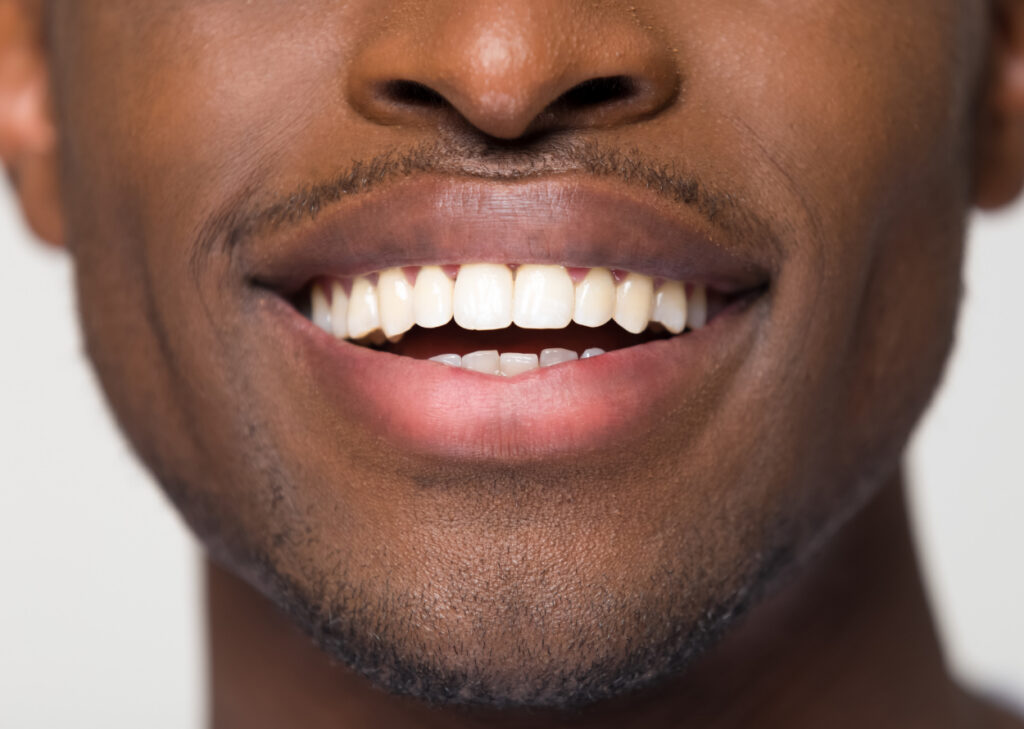
Natural tooth enamel is semi-translucent. It has a layered optical structure that allows light to enter, scatter through the dentin beneath, and exit at a slightly different angle than it entered. This creates the subtle depth and warmth you see in a healthy, unenhanced smile. The incisal edges — the tips of your front teeth — often appear slightly transparent or blue-grey in natural light. That’s not a flaw. That’s optical authenticity.
Modern ultra-thin ceramics used in minimal-prep workflows are engineered to replicate this behavior. The material is thin enough that it doesn’t block light transmission the way thicker, more opaque veneers do. When a ceramist layers the porcelain correctly — building in gradients of translucency from the gumline to the incisal edge — the result interacts with light the way your natural enamel would.
No before-and-after photo fully captures this. It’s something you notice in motion, in different lighting conditions, when someone is talking and laughing — not just when they’re posing for a photo.
The Beverly Hills Difference: Chairside Ceramist Collaboration
Ceramic science is only half the equation. The other half is the human judgment that goes into shade-matching and characterization — and that process is far more nuanced than selecting a shade from a standard guide.
Our practice collaborates closely with a master ceramist lab located right here in Beverly Hills. This proximity matters. It allows for chairside consultations during the design phase, where your natural tooth color, the specific undertones of your skin, and even the way light moves through your smile in our office can all inform the final ceramic prescription.
A ceramist working from a shade tab and a photograph alone is working with incomplete information. A ceramist who has seen your smile in person — and who communicates directly with your dentist throughout the process — can build in the micro-characterizations, the subtle value gradients, and the incisal translucency that make a veneer indistinguishable from a natural tooth. This level of bespoke collaboration is central to our custom smile design process and reflects the “quiet luxury” standard our Beverly Hills patients have come to expect.
Am I a Candidate for Minimal-Prep Veneers?
Minimal-prep veneers are not universally appropriate, and it’s important to be transparent about that.
Patients who may be well-suited for a minimal-prep approach typically include those with:
- Mild to moderate cosmetic concerns — discoloration, minor spacing, slight shape irregularities
- Sufficient existing enamel thickness — enough structure to support strong adhesive bonding
- A healthy bite — no significant bruxism (teeth grinding) or occlusal issues that would place excessive force on thin ceramics
- Realistic expectations — understanding that ultra-thin veneers have specific maintenance requirements
Patients with more significant structural concerns, deep discoloration that penetrates the dentin, or substantial bite issues may require a different restorative approach to achieve a safe and lasting result. In some of those cases, traditional preparation veneers or other restorations may actually be the more conservative long-term choice — because attempting minimal prep on the wrong candidate can compromise both aesthetics and tooth health.
This is why we never recommend a veneer type before completing a full smile evaluation. The goal is always to find the approach that serves your health and your aesthetic goals together — not to fit every patient into the same solution. If you’re also thinking ahead about timing and investment, our guide to understanding cosmetic dentistry phasing and costs walks through how to approach a multi-stage treatment plan thoughtfully.
What To Do Next
Ready to find out if minimal-prep veneers are right for your smile?
The best place to start is a personalized smile consultation at our Beverly Hills practice. We’ll evaluate your existing tooth structure, discuss your aesthetic goals, and give you an honest, clinical assessment of which approach — minimal prep, traditional, or something else entirely — is most likely to give you the natural, undetectable result you’re looking for.
There’s no pressure and no one-size-fits-all treatment plan here. Just a thorough conversation between you and a dentist who takes both your health and your aesthetic vision seriously.
Schedule Your Smile Consultation →
Or call us directly to speak with our team. We’re happy to answer your questions before you ever set foot in the chair.
 Dental Emergency Anxiety: How Modern Clinics Ensure You ‘Don’t Feel a Thing’