Dental implants are described as permanent, and that word does a lot of heavy lifting. A better way to think about it is this. An implant is a long-term restoration with three separate parts, and those parts age at different rates.
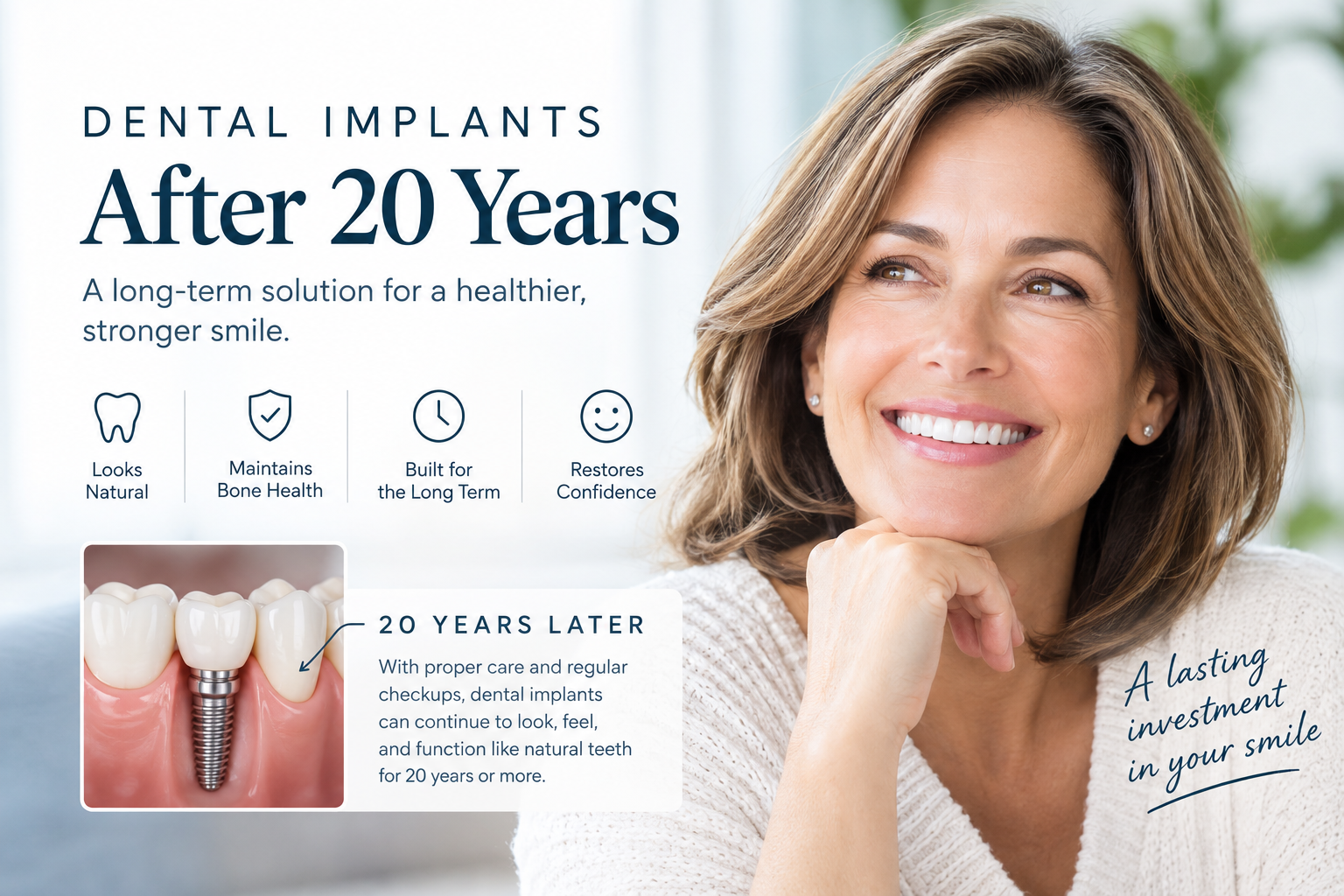
If you are considering implants now, or you already have implants and want to know what the next two decades look like, here is a realistic picture. No scare tactics, no promises nobody can make.
The three parts of an implant, and how each one ages
Understanding what actually changes over time is easier once you know what an implant is made of.
- The fixture. This is the screw-shaped post, usually titanium or zirconia, that integrates with your jawbone. It is the part designed to stay put for the long haul.
- The abutment. A connector piece that links the fixture to the visible tooth. It can loosen or, less commonly, fracture.
- The crown. The visible tooth, typically porcelain or zirconia. This is the part most likely to need attention over 20 years.
That distinction matters. When someone says their implant failed, they often mean the crown chipped or the screw loosened. That is a repair, not a failure of the implant itself.
What the research says about long-term survival
Peer-reviewed long-term studies generally report high survival rates for dental implants at 10 years and beyond in healthy, well-maintained patients. Twenty-year data exist but are thinner, because implant designs, surfaces, and surgical protocols have changed considerably over that time.
The practical takeaway is that reported outcomes vary meaningfully depending on the patient’s health, bone quality, smoking status, gum condition, bite forces, and whether they kept up with professional maintenance. An implant in a nonsmoker with healthy gums who comes in for regular care is in a very different situation from one in a patient with uncontrolled diabetes and untreated periodontal disease.
Ask your dentist what the realistic outlook is for your specific case rather than relying on a general number.
What actually changes over 20 years
The crown is the part most likely to need replacing
Porcelain can chip. Bite forces gradually wear the biting surface. The screw holding everything together can loosen and need retightening, which is a straightforward in-office fix when caught early.
Replacing a worn implant crown is usually far simpler than the original surgery, since the fixture stays where it is.
The gum tissue can recede
Over years, the gum around an implant can recede slightly, which may expose a gray metal margin on a front tooth. This is primarily a cosmetic concern, and it matters more in the smile zone than on a molar.
Your natural teeth keep moving, and the implant does not
This is the change most patients never hear about beforehand, and it is important.
Natural teeth continue to shift and erupt very slowly throughout adult life. An implant is fused to bone and does not move with them. Over 10 or 20 years, that can leave an implant crown sitting slightly lower than its neighbors, or open a small gap where food catches.
This is well documented in the literature and is not a sign that anything went wrong. It is usually managed by replacing or modifying the crown when it becomes noticeable.
Bone levels around the implant can change
Implants do not get cavities. The bone and gum tissue around them can still develop problems.
- Peri-implant mucositis is inflammation of the soft tissue around an implant without bone loss. Caught early, it is generally reversible with professional cleaning and improved home care.
- Peri-implantitis involves inflammation plus loss of supporting bone. It is more difficult to treat and is the leading biological reason implants are eventually lost. Early detection makes a substantial difference in outcome, which is the entire argument for regular monitoring.
What raises your risk over the long run
Some factors are within your control and some are not. Knowing them lets you act on the ones you can influence.
- Smoking, which is consistently associated with poorer implant outcomes.
- Uncontrolled diabetes and other conditions that affect healing and immune response.
- A history of gum disease, which raises the risk of peri-implantitis.
- Grinding and clenching, which loads the implant and its crown beyond what they were designed for.
- Skipping maintenance visits, which is how small problems become large ones.
- Inadequate home care, especially around the gum line where the crown meets the tissue.
How to make your implants last
- Keep your maintenance schedule. Implants need professional cleaning with implant-safe instruments. Standard metal scalers can scratch implant surfaces, which is one reason implant maintenance is its own skill.
- Get periodic X-rays. Bone level around an implant is measured on radiographs, and change is often visible before you feel anything.
- Have your bite checked. Occlusion shifts over the years. A bite adjustment is quick and can prevent a fractured crown or a loosened screw.
- Wear a nightguard if you grind. This is one of the highest-value protective habits for anyone with implants and a bruxism history.
- Clean around the implant daily. Interdental brushes, floss designed for implants, and water flossers all help reach the areas a toothbrush misses.
- Say something early. Bleeding, tenderness, a change in how the tooth feels, or food packing in a new spot are all worth a call rather than a wait.
Long-term implant care in Beverly Hills
At Dental Group of Beverly Hills, Dr. Nuriel Lavi and Dr. Tariq Jabaiti approach implants as a long relationship rather than a single procedure.
That means Cone Beam CT imaging for three-dimensional planning and monitoring, digital X-rays for tracking bone levels over time, and maintenance appointments built around what your implant actually needs.
Dr. Jabaiti earned his DDS at the Herman Ostrow School of Dentistry at USC and serves there as a Faculty Professor. Dr. Lavi has been recognized with the California Best Dentist Award and by America’s Best Dentists. Both bring the same approach to these conversations, which is to explain what they see, show you the images, and let you make the call.
If you have implants placed elsewhere and want them evaluated, we are happy to take a look. Bring your records if you have them.
Protect what matters most: your health and your smile
Twenty years is a long time, and the patients whose implants are still doing well at that point almost always have one thing in common. They kept coming in.
Schedule your implant check today. Call (310) 271-3003 or book online, and we will walk you through exactly where things stand.
Dental Group of Beverly Hills, 8641 Wilshire Blvd, Suite 125, Beverly Hills, CA 90211.
Frequently Asked Questions
Do dental implants need to be replaced after 20 years?
The implant fixture itself often does not, provided the surrounding bone stays healthy. The crown on top is the component most likely to need replacement or repair over that timeframe due to wear, chipping, or changes in how it lines up with your other teeth. Your dentist can assess each part separately.
Can you get gum disease around an implant?
Yes. Peri-implant mucositis affects the soft tissue and is generally reversible when caught early. Peri-implantitis also involves bone loss and is more difficult to treat. Regular professional monitoring with X-rays is how these are detected before they progress.
Why does my implant crown look shorter than my other teeth?
Natural teeth continue to shift very slowly through adult life, while an implant stays fixed in the bone. Over many years, this can leave the implant crown to sit slightly lower than its neighboring teeth. It is a recognized long-term change and is usually addressed by modifying or replacing the crown.
Does grinding my teeth affect my implants?
It can. Grinding places sustained force on the crown, the abutment screw, and the bone around the implant. A custom nightguard is commonly recommended for patients with a grinding habit, and having your bite checked periodically helps catch problems early.
How often should I have my implants checked?
Most patients are advised to keep the same professional cleaning and exam interval their dentist recommends for their natural teeth, with periodic X-rays to monitor bone levels. Your specific interval depends on your gum health, medical history, and grinding habits.
 Why Do Dentists Push for Crowns in Beverly Hills? An Honest Explanation