Written by the clinical team at Dental Group of Beverly Hills | Reviewed by Nuriel Lavi, DDS
You went in for a cleaning. You came out with a treatment plan for three crowns and a number that made you blink. If that has happened to you at a Beverly Hills or West LA practice, you are not imagining things, and you are not alone in feeling suspicious about it.
Here’s what gets lost in that moment. Crowns are a legitimate and often necessary treatment. They are also, in some situations, recommended when a more conservative option would work just as well.
Knowing the difference is the whole game. Below is a breakdown of when a crown is genuinely the right call, when it may not be, and the specific questions that separate a sound recommendation from a sales pitch.
What a crown actually does
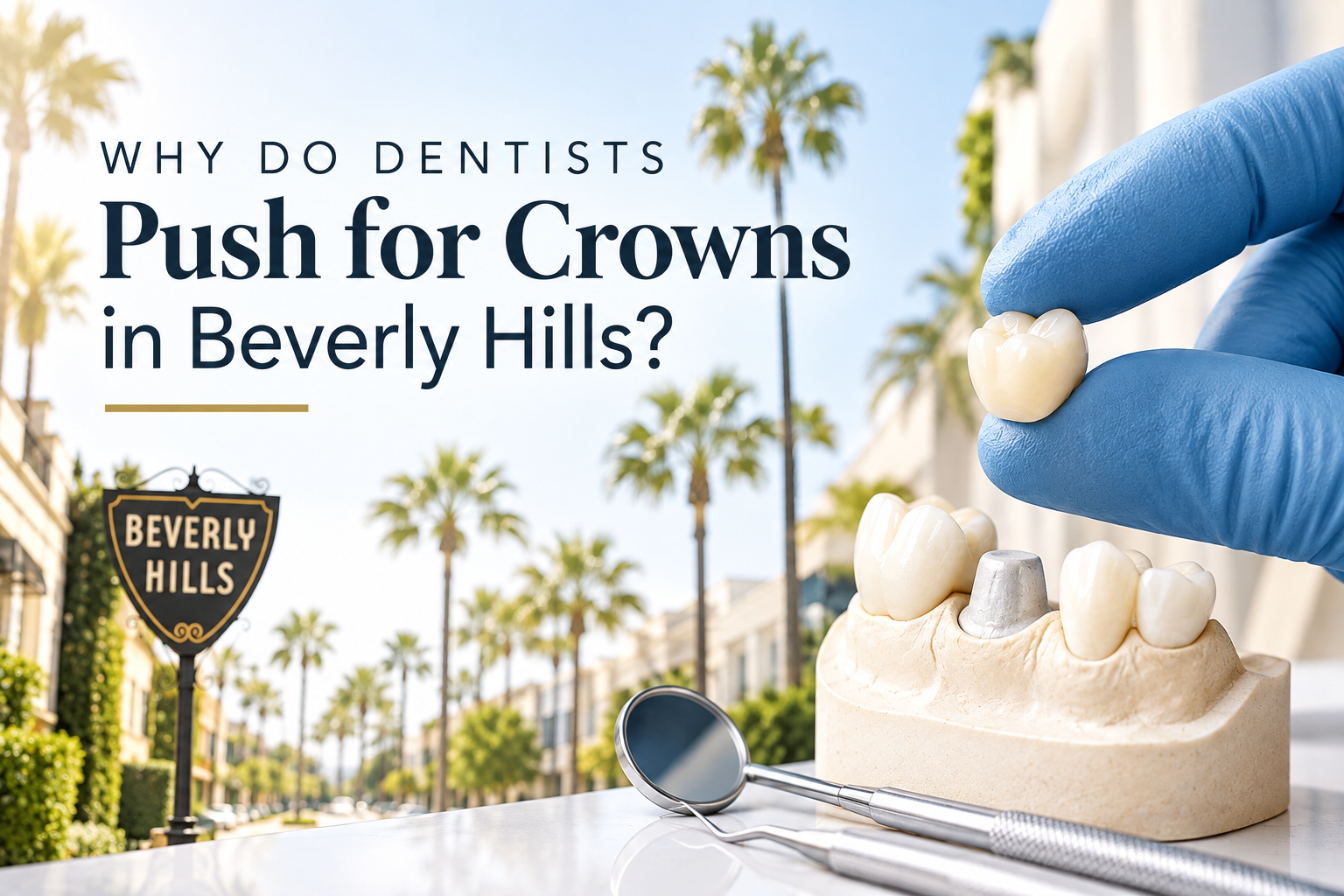
A crown, sometimes called a cap, covers the entire visible portion of a tooth. It is cemented or bonded in place and takes over the job of holding the tooth together.
The key word is holding. A filling replaces missing tooth structure from the inside. A crown wraps around the outside and binds the remaining walls of the tooth so they cannot flex apart under chewing force. Those are two different mechanical jobs, and that difference drives most legitimate crown recommendations.
When a crown is genuinely the right recommendation
- After a root canal on a back tooth. Molars and premolars absorb heavy chewing loads, and a tooth that has had root canal treatment has lost internal structure. Covering the cusps is widely considered standard care for these teeth because unprotected molars are at meaningful risk of fracturing.
- A cracked tooth. If a crack runs through a cusp or across the chewing surface, a crown holds the segments together. A filling placed in a cracked tooth can act like a wedge under pressure.
- Very little tooth left. When decay or an old restoration has consumed most of the tooth, there may not be enough sound structure to anchor a filling. At a certain point, adding more filling material creates a restoration that is mostly filling and very little tooth.
- A large old filling that has failed. Big amalgam fillings placed decades ago can leave thin, undermined walls behind. Once one of those walls fractures, a crown is often the practical repair.
- Severe wear or erosion. Advanced grinding or acid erosion can shorten teeth enough that full coverage is needed to restore both function and height.
A tooth supporting a bridge or a partial denture. These teeth carry loads they were never designed for and usually need full coverage.
When something less than a crown may be enough
- A moderate cavity with healthy walls remaining. A well-placed bonded composite filling can serve for years. Not every cavity graduates to a crown.
- An inlay or onlay. These are lab-made or milled restorations that replace only the damaged portion of the tooth and leave healthy structure alone. A modern bonded onlay can protect a cusp without reducing the whole tooth. This middle option is a genuinely conservative choice that not every treatment plan mentions.
- A small crack with no symptoms. Some enamel craze lines are cosmetic and stable. Monitoring with photographs over time is a reasonable approach when there is no pain, no sensitivity, and no sign the crack is progressing.
- A worn but stable tooth. Wear that is being managed with a nightguard may not need restoration at all right now.
So why does it sometimes feel like a push?
Several things can be happening at once, and most of them are not fraud.
- Different treatment philosophies. Some dentists restore proactively to prevent a future fracture. Others watch and wait. Both approaches have defenders in the literature. Neither is automatically wrong. What matters is whether the reasoning was explained to you.
- Production pressure in some corporate and high-volume settings. In practices where providers are measured on production numbers, the incentive structure can nudge recommendations toward higher-value procedures. This is a known dynamic in the industry and worth understanding as a patient.
- Poor communication rather than bad intent. A dentist who never showed you the photo, never explained the alternative, and handed you a printed plan at checkout may have made a perfectly sound clinical call. It simply did not feel that way to you.
- Insurance shaping the conversation. Some plans cover a crown but downgrade coverage on an onlay, or vice versa. That can quietly influence what gets presented.
Five questions that get you a straight answer
Ask these, in this order. A dentist who is confident in the diagnosis will not mind a single one.
1. Can you show me the photo and the X-ray of this tooth? Intraoral cameras are standard in modern practices. You should be able to see what your dentist sees.
2. What happens if I wait six months? A real answer sounds like a risk description. If the answer is only urgency with no explanation, note that.
3. Is an onlay or a filling an option here, and why or why not? This is the single most revealing question. It asks directly whether the conservative path was considered.
4. How much healthy tooth gets removed? Crown preparation is not reversible. It is fair to know the trade-off.
5. Can I have this in writing with the fee for each option? Written options let you think it over at home, which is exactly where these decisions should be made.
How we handle it at Dental Group of Beverly Hills
Dr. Nuriel Lavi and Dr. Tariq Jabaiti built this practice around a simple idea. You should leave understanding your mouth, not just holding an invoice.
Dr. Jabaiti earned his DDS at the Herman Ostrow School of Dentistry at USC and serves there as a Faculty Professor, which means he spends part of his week teaching other dentists how to reason through exactly these cases. That habit carries into the operatory.
In practice, that looks like this. We show you your own intraoral photos and digital X-rays on the screen. We use an iTero 3D scanner so you can see the shape and wear of your teeth without messy impression putty. When a conservative option exists, we tell you about it, including what it costs and what its limitations are. Then you decide on your own timeline.
Patients tell us this repeatedly in their reviews. Hundreds of Beverly Hills patients have written some version of the same sentence, which is that they were informed, never pressured, and never sold.
Getting a second opinion is normal
If a crown plan does not sit right with you, getting another set of eyes on it is a reasonable and common thing to do. Bring your X-rays if you have them, or we can take new images.
Sometimes a second opinion confirms the first plan, and you proceed with confidence instead of doubt. Sometimes it opens up a more conservative path. Either way, you end up making the decision with full information.
Schedule your visit today. Call (310) 271-3003 or book online.
Dental Group of Beverly Hills, 8641 Wilshire Blvd, Suite 125, Beverly Hills, CA 90211.
Frequently Asked Questions
Do I really need a crown after a root canal?
For back teeth, full coverage is widely considered standard care because molars and premolars carry heavy chewing forces and a treated tooth has lost internal structure. Front teeth with conservative access openings can sometimes be restored with a bonded filling instead. Ask your dentist which category your tooth falls into and why.
Can I get an onlay instead of a crown?
Often yes, when enough healthy tooth structure remains and the tooth is not badly cracked. An onlay replaces only the damaged portion and preserves more natural tooth. Whether it is appropriate for your tooth depends on how much structure is left and where the forces land in your bite.
How long do dental crowns last?
Longevity varies considerably with material, bite forces, grinding habits, gum health, and home care. Some crowns serve for many years, while others need replacement sooner. Your dentist can give you a more specific expectation once they have evaluated your bite and the tooth underneath.
Is it rude to ask for a second opinion?
Not at all, and most dentists expect it on larger treatment plans. You are entitled to copies of your own X-rays and records. A practice that reacts badly to the request has told you something useful.
Why did one dentist say I need a crown and another said a filling?
Both may be defensible. Dentists differ in how proactively they restore teeth, and the same tooth can look borderline to one clinician and clearly failing to another. Ask each of them to walk you through the image and explain the risk of the more conservative choice.
 Root Canal Alternatives in Beverly Hills: What Your Options Actually Are